so much depends
upon
a red wheel
barrow
glazed with rain
water
beside the white
chickens
The Red Wheelbarrow—William Carlos Williams
Today in these United States of Insanity, we grieve, we mourn, we shriek with the rage of the powerless, and the luckiest of us turn to Art for solace, for refuge, for healing, for momentary escape from the pain.
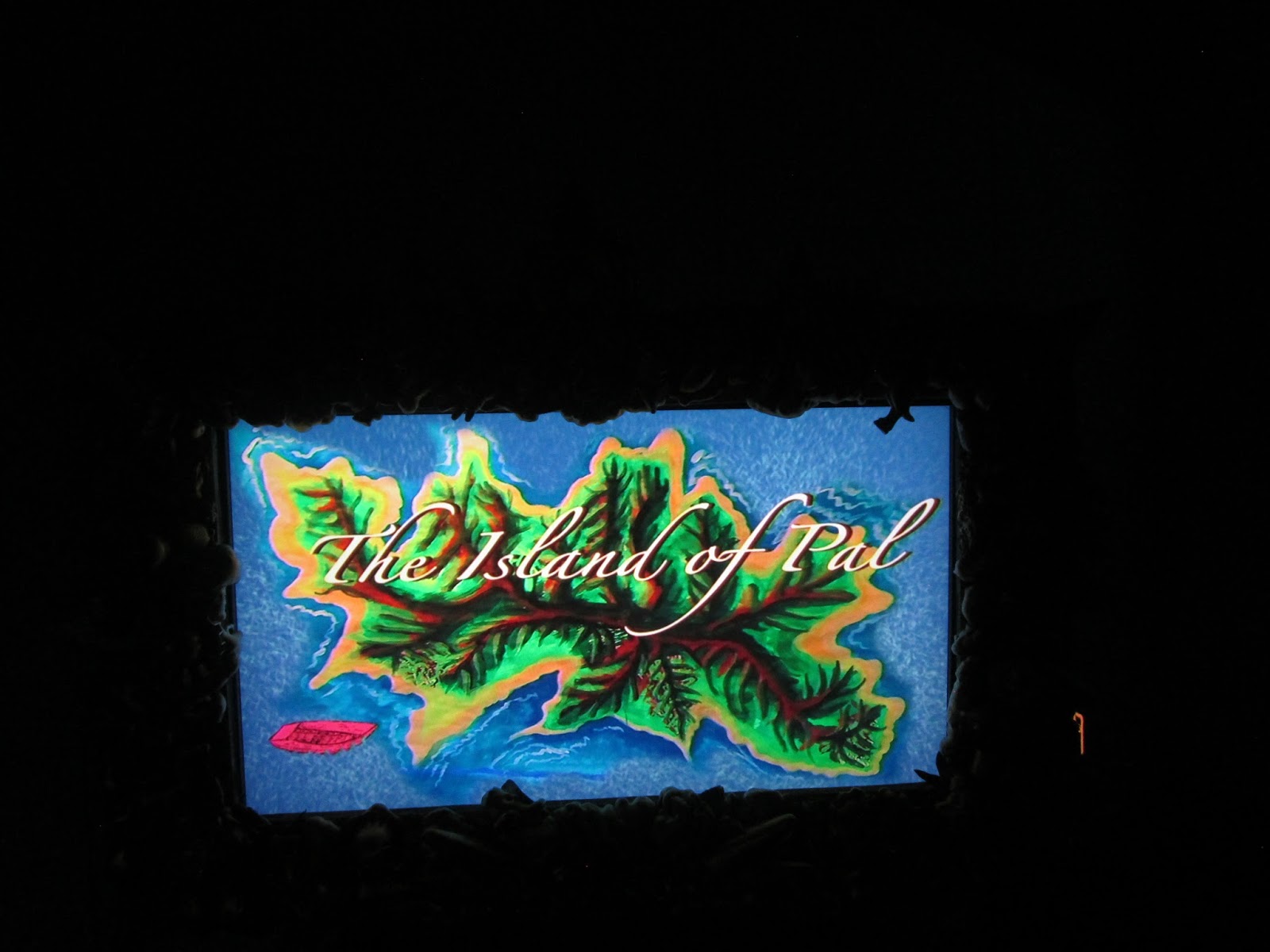
In Anne Farrell's The Island of Pal little red skiffs float on undulating waters, but so do armchairs,
fully made beds, and spiraling severed horses' heads in the throbbing
air. Three toy horses are posed on synthetic turf in a theatrically
raked trapezoidal corral bordered by tiny rope footlights. No bridles or
saddles are ever in view; these are wild horses temporarily and
ever-so-lightly penned in by a white picket fence. Enclosed inside the skewed geometry and oblique angles the equine
visitors—a palomino named Pal, a buckskin called Bonnie, and her
sometimes partner, the black-coated Clyde—are here to entice playmates.
A Plexiglas case contains two 3-D printed plastic spoons, one long
and white, one short and black, each fancifully decorated with a frilly
wide bow, suggestive of extravagant gifts and luxurious party dresses.
Despite their differences in size and color, these spoons—emblems of the
acts of feeding, digging, music-making—cohere; a second case protects a
single small boat devoid of either passengers or cargo, its red and
black paint painstakingly applied to appear weathered, and by inference,
traveled. But how, with no oars or engine or agent, human or otherwise,
aboard?
Projected on the far wall are two separate animated images, picture
window size. On the left is an island in the distinct form of a leaf,
and a pond in the shape of a giant amoeba in which renderings of
magnified corpuscular cells pulse on the surface like fibrillating lotus
blossoms. These projections of leaf island and amoeba pond, which
foreground the rippling, writhing instability of both land and water,
help attune us to Farrell's primary preoccupation in this work—the shape
of things. In all meanings: the particular external forms of her
objects, but also their condition, what shape are they in? What is their
fitness for continued existence and what will be the quality of that
existence in a world where lands are gobbled for development, water is poisoned by industrial polluters, and beautiful wild things go tragically extinct, daily.
Farrell terms them “maps,” but hers is no ordinary cartography, at
least the directions are not cardinal points on a magnetized compass,
and the landmarks are referenced by her quotidian spoons and beds and
chairs and skiffs. We might call hers an "onto-cartography"
in that what she's mapping is being itself. Why would Farrell even
attempt new maps, even symbological ones, if not to urge the need for,
and possibility of, a reorientation? Maps are invitations, future
forward ones; they move us onward, if only in our imaginations.
Discovering the depth of the realms being sounded and charted by Anne
Farrell, or at least trying to, is but part of the joy of engaging with The Island of Pal.
On the installation's side wall near the floor, its lowly placement a
curiosity in and of itself, diminutive images of certain selected
elements are projected in a slow and steady slide show. The lilliputian
display reminds us to read the objects qua objects, absent their
environments. Here we can let all of our uncensored associations froth
to the surface—charms in a board game, Van Gogh's Bedroom in Arles,
Kandinsky's psycho-spiritual canvasses, the horse's head in The
Godfather, coinage of fallen empires, and so on.
We're also cornered into a consideration of dimensionality, as we share
space simultaneously with the artifacts themselves and their various
pixelated visual representations. Transformation too is in the
mix—spoons were once pixels (before they were read and 3-D printed) and
become pixels again in the digital animation.
The ambient sound-scape permeating the installation offers no aural
clues to an easily identifiable reality: ambiguity is amplified, mystery
resounds, here ecstasy is still possible.
Inside a bricolage gilt frame is a screen upon which a ten-minute
video containing all of these disparate constituents (and new characters
too) is played in a loop. Also called The Island of Pal, the
video is a dream narrative of Pal, Bonnie, and Clyde (neo-mythical names
for fantastical beings) delighting in an idyll of grasslands and
wildflowers. The animation makes no attempt to be lifelike. While the
horses' plush tails do swish, their legs don't bend; they don't gallop
so much as absurdly hop all four legs at once from point to point, or
they hurtle through space without touching down at all.
The video has its own soundtrack filled with the ringing tones of
chimes and plinking, tinkling bells, accessible by headphones. One comes
to feel that this music is generated from our host Pal's own
imagination as he frolics and flies about the landscape, striking notes
and chords all beautifully pleasing to his toy horse ears. Decorative
flourishes like cascading stars and dancing curlicues stir the
atmosphere into a climactic vortex, but without any sense of menace or
negative consequence in the controlled chaos of creation. A gleaming
metallic robotic mannequin sits on a boulder contemplating the marvelous
"natural" setting, peaceably co-existing with all beings—parasites and
pollinators, alike; at first the robot is bare, but then covers itself
in a diagonally-striped tigerish mini-dress. Amongst a deluge of falling
leaves, it departs, its “spirit” stirred and refreshed, ready to hit
the dance floor.
On December 5, 2014, in what can only be described as a 92-page hissy fit, U.S. Judge James O. Browning, who we must never forget was appointed by torturer-in-chief George W. Bush, let his freak show for all the world to see.
I am referring to Judge Browning's Order GRANTING the motion of the Mora Land Grant and Jacobo Pacheco, as Intervenors in Swepi v. Mora County. This is the suit that Swepi, a subsidiary of Royal Dutch Shell, has brought against Mora County to try to overturn its historic anti-fracking ordinance. With every fiber of his being, hizzoner wanted to deny the motion and send the Intervenors packing, but he was hamstrung by...wait for it...the law! From page 2 of the Order:
The Court disagrees with the relevant Tenth Circuit environmental case law, but it is bound to follow and apply the law fully and faithfully. If the Court were not required to grant the Motion under rule 24(a), however, it would not permit intervention...
Most of the other 90 pages drive that point home every which way. His clerks must have been burning the midnight oil faithfully writing their exhaustive critique of the Tenth Circuit's decision that forced Browning's hand Mother Nature's way. The experience of reading Browning's Memorandum Opinion and Order is like being cornered by a
too-close-talking drunk at a bar who thinks he is witty (but mostly just
smells like salami and weird socks) while he rants at you about his
endless tedious feuds with people you don't know. And all that while
you're still waiting for your first drink!
But on and along page 80 of the Order appeared a passage on creativity and the law so anomalous that it begged for scrutiny. Browning writes:
Moreover, with the Tenth Circuit’s lenient rules in finding a protectable interest, any
private party, with a creative enough attorney, can intervene in a case in which the government is a party.
Creativity, in the judge's parlance, is not a good thing--egads, it leads to partycrashing!
Judge Browning continues:
One intervenor may have an interest in hunting in a flat grassy region of the county and another in a mountainous wooded area.One intervenor may have an interest in fishing in lakes and ponds, and another in fishing in streams and creeks.
Here Judge Browning's examples belong to the realm of topography. I turn to philosopher Levi Bryant who makes a distinction between topographical maps and vector maps in Onto-Cartography, An Ontology of Machines and Media (Edinburgh University Press, 2014). According to Bryant, a topographical map is a "sort of snapshot of worlds or assemblages at a particular point in time." But vector maps "chart the trajectories along which worlds are unfolding."
This is our fundamental conflict, Judge Browning's and mine. He's judging from the position of Mora's present unspoiled landscape without a thought to the trajectory that will unfold as a result if Swepi were to somehow prevail. He continues:
One intervenor may have an interest in studying specific foliage, and other intervenors have interests in studying other foliage.
"Specific" and "other" are his descriptors for foliage. There's an almost autistic dispassion at the thought of leaves.
Leveland, Texas where Judge Browning was raised. Not a leaf in sight!
He has no terms to differentiate one from another, even for purposes of illustration.
No wonder creativity is so threatening, a theme he returns to in this next passage:
One intervenor photographs the forests and the landscapes; another paints. With a creative enough attorney, an intervenor -- or dozens of intervenors -- can think of specific enough interests that a case may impair, and, once the interest prongs are satisfied, the intervenors automatically satisfy rule 24(a)(2), because, according to the Tenth Circuit, a government entity is incapable of adequately protecting these private interests in spite of the common objectives.
Now I understand that the Tenth Circuit is as dirty as they come. Be that as it may, I just want to say thank you to them that they were able to face that last bit of reality: a government entity is incapable of adequately protecting these private interests...
Having the Intervenors join the Mora County Commission in its defense against Swepi has already strengthened the case to protect the Ordinance. The Intervenors are pursuing Discovery with all due diligence and on Monday, December 8th, they filed a first set of Discovery requests, which could lead who knows where...? Judge Browning will be hard put to dismiss these requests, 36 in all. He'd have to torture the law to make them disappear.
In Earth, Maps and Practices, the final chapter of Onto-Cartography, Bryant adds a third type of map--modal maps:
Modal maps map futures that could exist if we were to intervene...the environmental activist might note that the world is unfolding along a particular vector that will, in the future, lead to the extinction of thousands of organisms, world hunger because of changes in agricultural conditions, more destructive weather events, and tremendous economic and political instability as people fight over resources. A modal map would consist of acting on the topography of the present to produce a possible future that would avoid this fate.
I would like to remind Judge Browning of the oath he swore on August 1, 2003 during the Bush torture era when he received commission. “I, XXX XXX, do solemnly swear (or affirm) that I will administer
justice without respect to persons, and do equal right to the poor and
to the rich, and that I will faithfully and impartially discharge and
perform all the duties incumbent upon me as XXX under the Constitution
and laws of the United States. So help me God.”
Levi Bryant's new book
Onto-Cartography: An Ontology of Machines and Media is available for
pre-order, which is very good news for activists everywhere. As the
title indicates his original theoretical concept is a way to map
being, maps that can help one to see things
as they really are, the better to locate the sites and pathways for
possible change.
In his own words:
The “onto” of “onto-cartography”
refers to the word “ontic”, from the Greek ὄντος, denoting
materially existing entities, substances, or objects. “Cartography”,
of course, is the practice of constructing or drawing maps. An
onto-cartography would thus be a map or diagram of things—and more
precisely things and signs–that exist within a field, situation, or
world.
By “situation” or “world” I
mean an ordered set of entities and signs that interact with one
another. A world or situation is not something
other than the externally related entities and signs within it, but is identical to these entities and
signs.
Onto-cartography is thus not a map of
space or geography—though we can refer to a “space of things and
signs” in a given situation or field and it does help to underline
the profound relevance of geography to this project insofar as
onto-cartographies are always geographically situated–but is rather
a map of things or what I call machines. In particular, an
onto-cartography is a map of the spatio-temporal gravitational fields produced
by things and signs and how these fields constrain and afford
possibilities of movement and becoming.
(The whole of the talk can be found
here for those of you like me who yearn for an affirming theory
largely verifiable in one's own experience—lived, dreamt or
imagined.)
Because what I'm mapping right now is
the possibility of substantive change in New Mexico in various
spheres—in ecosystems in which Lamy, LaBahada and the Ortiz Mountains are situated, all currently acutely at risk from the
predations of oil & gas, basalt and gold mining industries,
respectively. A second community meeting is scheduled in Lamy tonight
with a thrilling agenda item: under consideration is the possibility
of joining forces in a regional alliance. What is that but a kickass
spatio-temporal gravitational field about to seriously constrain
Power's usual moves?
One Billion Rising Santa Fe, 2013
It's also a most exciting time to be a
prisoner-rights activist. Under the aegis of New Mexico Women's Justice Project a public meeting to strategize how most efficaciously
to push back against the notional plan to expand the women's prison
in Grants has been called. One Billion Rising Santa Fe has embraced
our intiative and I will be speaking at the Roundhouse on V-DAY,
adding my voice to others calling for justice and an end to violence
against women in New Mexico. Our bold text (Bette Fleishman's and
mine) will be included in the memorial resolution presented at
Legislature.
Further we have been invited at 8:30am
on Wednesday, February 19th to appear on The Julia Goldberg Show, a local politically-focused talk radio show hosted by
the former editor of the Santa Fe Reporter. Under her editorial
leadership the weekly newspaper published Fallen Woman, an
exposé of the Women's Prison in Grants conducted in 2008 by Silva
Talji, an important foundational layer upon which we can build.
In addition, the New Mexico Center on Law and Poverty and ACLU of New Mexico released their joint study of
the uses of solitary confinement in prisons and jails in New Mexico: INSIDE THE BOX.
I have read the report in its entirety (it's only 18 pages) and their
recommendations must be urgently put forward along with our demand
that the RFP for the expansion of the Women's Prison in Grants never
see the light of day!
From page 3 of their report:
New
Mexico urgently needs to reform the practice of solitary confinement
in its prisons and jails. TheNMCLP
and the ACLU-NM urge New Mexico to adopt the following reforms:
1.
increase transparency and oversight of the use of solitary
confinement
2.
limit the length of solitary confinement to no more than 30 days
3.
mandate that all prisoners are provided with mental, physical and
social stimulation
4.
ban the use of solitary confinement on the mentally ill
5.
ban the use of solitary confinement on children
Children!
Concerned that the Department of
Corrections was not meaningfully addressing the documented suffering
of the prisoners under their care, especially if the intention was to
expand the women's prison, I phoned Steven Robert Allen,
Director of Public Policy of ACLU-NM. He assured me that the response
was more nuanced and pointed me to the meeting minutes where Inside
the Box was presented at Legislature and discussed. In Allen's view
the fact that Corrections has brought in the VERA Institute to review
the practices around solitary is an enormous positive. He told me
that the department has already committed to a 50% near-term
reduction in the use of solitary.
While welcome news of course, I
wondered at the arbitrary number as opposed to a set of principles by
which practice could be evaluated—what if 85% of prisoners
currently languishing in solitary could justifiably be released, or
89%? What relevance would the 50% number have in that instance? Allen
doesn't see it as a numbers game. “VERA Institute has an amazing
track record in achieving systemic change; I am somewhat optimistic
about the commitment at the State level. Secretary Marcantell is
taking positive steps in the right direction.”
More worrisome to Allen are the 29
counties with detention facilities, jails and municipal lock-ups where
basic data are not collected in a standard or uniform way. “We do
not have a homogeneous situation. We need a unified standard for use
of solitary confinement at every level in New Mexico. Perhaps that is
something that could be remedied by passage of a State law in the
Legislature.” Judging from the November minutes, I wondered about semantics. “The counties are
defining solitary in some Cool Hand Luke kind of way, where they
throw a prisoner in a hole or something,”Allen explained. “So of
course they can say, We don't have solitary in our jails.” But the
$15.5 million jury award to Stephen Slevin who was confined to solitary in
Dona Ana County for over two years and a suit settled with Valencia
County this week resulting in an award to Jan Green of $1.6 million
fly in the face of those demurrals.
And finally, another powerful site of
onto-cartographical hope resides in Albuquerque. Young Women United has initiated a Indiegogo campaign Everyday Struggles, Everyday Strength to raise $2,000 to produce a
short educational video about women and addiction, hoping to help
reframe the issue of substance abuse away from criminality to a more
rational response. This is a key component for our fight because 75%
of the women in prison in Grants are there for non-violent drug
charges.
We hope to see you in Santa Fe on the 19th! Details below: