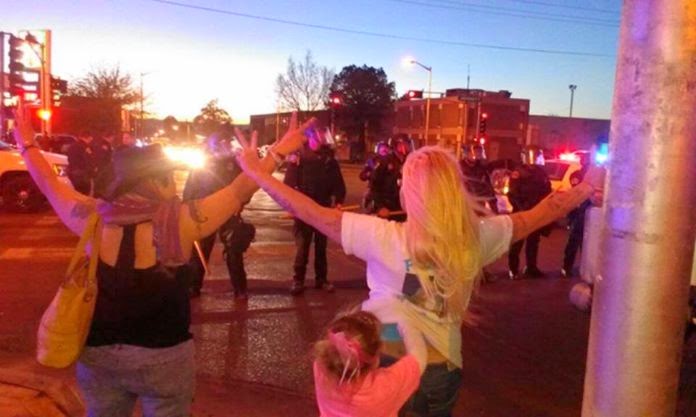
Power has greatly abused its authority
in New Mexico and some of us are trying to do something about that in
various arenas, but particularly in the struggle to end police
violence in Albuquerque. We're confronting power, we're directly
challenging the people who lay exclusive claim to it, and we're
rebalancing the power relations between us.
Our efforts must be
working quite well, because the city administration's tactics are
gaining in repugnance what they lack in credibility—witch-hunts of one stripe or another,
patently obvious perversions of our own institutions to punish us for defiance in the face of lawlessness. For what is Unconstitutional Policing if not the zenith of
lawlessness?
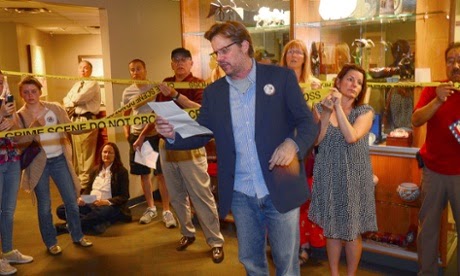
The results of a new KRQE poll are telling. As is this remarkable video footage of what is being purported to be the basis of a felony charge ludicrously pending against David Correia, one of the Burque 13.
More Dirty Dancing than the Dirty Dozen, I'd say.
In grossly over-charging David (as the video
plainly shows and the New Mexico Mercury reports) Power's lackeys do our job for us--eyes are opening to injustice; people, and not just White people, are shaking off their stupor.
According to the autopsy report, Mary Hawkes,19, took three kill shots. Bullets at a downward angle entered her ear, neck and shoulder. APD Officer Jeremy Dear, her acknowledged shooter, is still at large.
The sheer fact of the over-charge, however, the show of
force it represents, is presumably intended to have a chilling effect on our ever-growing coalition. But with
a pile of five dead bodies this Spring of Sorrows, Mary Hawkes' among them, the over-charge is having the opposite
effect—it's warming us up, instead. And in case you were wondering how low some alleged journalists can go...?
In threatening the mother of
the boy in the video with "child endangerment charges,” a boy whose father
was killed by the APD (they forgot to mention that in their story),
they have succeeded in pissing off just about everybody else not already
outraged by the killings.
COA Rick Perry wants the boy's mother to sink to her knees in fear and despair, but before that happens he'll
have to get past:
Nora Anaya
Dinah Vargas
Frances Madeson
and a
few other uppity women we know.
Further attacking our friend's family
is a non-starter. Ditto to not-so-subtly threatening parents who bring their kids
to marches and rallies. Somehow I don't see that message going over
so well with the Respect Albuquerque Women coalition. Not at all. In
trying to terrorize a single mama of three with the state-sanctioned kidnapping of her
children, they've probably quadrupled our attendance at Roosevelt
Park. And damn if Dinah didn't see them coming when she created this!
More information at www.apdprotest.org
Plus, I hear we've successfully booked Mala Maña! So
whatever else happens on Summer Solstice at Coal and Sycamore, it's going to be a spirited day of
beautiful music, dancing and community.
Speaking of the human community, I just
sent this lady a letter. It only takes a minute.
Chair-Elect
Mary Lynn Roper - NM Broadcaster's Foundation President/General
Manager KOAT-TV Albuquerque, NM 87125-5982 mroper@hearst.com
I don't know whether you were
sabotaged, blindsided or undermined by staff, but this propaganda parading as journalism is on you. With so much at stake, we're all watching you very closely to see how quickly and well you handle it. Good luck.
I am also posting this letter online as part of the "Over-Charging" blogpost on Written Word, Spoken Word. Please feel free to respond in the comments so everyone may have the benefit of your answer.
With every good wish for a thorough Spring cleaning,
All images with the "Burque 13" sign by Frances Madeson
At Santa Fe Community College:
At the Chavez Community Center:
At the Southside Public Library:
In the parking lot at Natural Grocers:
At the Paisano Market on Cerrillos:
At Trader Joe's on St. Francis:
At the Santa Fe Railyard:
At the Sambusco Center:
At The Cowgirl:
At the skatepark:
At the Santa Fe River:
At the Plaza:
The movement is in the coalition-building phase and we will be showing our strength (exponential growth) at a historic March/Rally at Roosevelt Park in Albuquerque (Coal and Sycamore) at 11a.m. The March/Rally will be held on Saturday, June 21st and it's conceived as a family-friendly, non-violent event. The park is a beautiful setting for a summer solstice experience, and all are welcome.
More information at www.apdprotest.org
For Santa Feans who understand that this is a viable movement for social change in New Mexico, and who wish to learn more--unmediated, in an intimate setting with the affected parties--about how we can help nurture the growing movement in Albuquerque, a fund raising event has been organized for Thursday, June 12th, from 6-8pm at a private home in Eldorado (more details below). Our modest goal is to raise $500 to help defray march expenses.
Mike
Gomez, whose 22 year old
son, Alan, was unarmed when he was shot and killed by APD. Mike and
his family successfully sued the city of Albuquerque. Mike has
emerged as a prominent activist confronting the brutality of the APD. (And we're all grateful to Mike for bailing out our friend Nora Anaya, another of the Burque 13.)
Entertainment
for the evening will be provided by:
Regina Ress, award winning storyteller, writer, and educator has
performed and taught in schools, homeless shelters, prisons,
international Storytelling Festivals, Lincoln Center and The White
House. She has a deep interest in social justice and prison reform.
She teaches “applied storytelling” at NYU. Here in Santa Fe, she
volunteers weekly at the Santa Fe County Jail.
Karma Lama will also be performing on bamboo
flute. His music has been described as inducing tranquility, peace and
contemplation.
More
musical entertainment to be announced!
Refreshments
will be served.
When you RSVP to Carmen at ctstone313@aol.com
or 505-699-8563, or Frances Madeson at francesmadeson@gmail.com
or 505-466-1048, we'll provide the location and directions.
“If you dare to
struggle, you dare to win. If you dare not struggle then damn it, you
don't deserve to win.” --Fred Hampton, August 1969, People's
Church, Chicago
It's the one-year anniversary of the
enactment of the anti-fracking ban in Mora County, and despite two
pending lawsuits the Ordinance is still the law of the land. In Mora,
oil and gas corporations, by strength of local law, are not allowed
to plunder Mora's earth and spoil its increasingly precious waters.
But as David Correia writes in
Properties of Violence, Law and Land Grant Struggle in Northern New
Mexico, “law is a site of social struggle where claims over
property are constructed and contested...while the law can be said to
mediate conflicts, it can also produce the conditions for those
conflicts.” It's those very conditions that the Ordinance redresses, blowing away “law” that undemocratically privileges
corporate rights over individual rights.
It's been an eventful twelve months.
Here's a quick recap of events to date:
April 29, 2013, Mora County
Commission enacts the “Mora County Community Water Rights and Local
Self-Government” Ordinance, the first countywide ban of fracking in
the nation. (For an excellent summary of events leading up to the
enactment of the ordinance please see
http://lajicarita.wordpress.com/2013/05/07/mora-county-takes-a-stand/)
November 15, 2013, Mora County
is sued in federal District Court by the trade group Independent
Petroleum Producers of New Mexico, landowner Mary L. Vermillion, the
JAY Land Ltd. Co., and Yates Ranch Property. The suit claims
violation of their rights under the First, Fifth and Fourteenth
Amendments to the U.S. Constitution.
November 26, 2013, Mora County
Commission votes unanimously to defend its Ordinance, which bans oil
and gas extraction and other hydrocarbons within Mora County. The
Commission also voted to hire Community Environmental Legal Defense Fund (CELDF), the New
Mexico Environmental Law Center, and Santa Fe attorney Dan
Brannen, a CELDF associate, to defend the Ordinance.
January 10, 2014, SWEPI LP, a
U.S. subsidiary of Royal Dutch Shell PLC, files a federal lawsuit
against Mora County, claiming the Ordinance violates state law and
the U.S. Constitution's equal protection and commerce clauses,
amounts to taking property without compensation, conflicts with U.S.
Supreme Court rulings that gave legal rights to corporations, and
violates other state and federal laws.
January 27, 2014, Mora County
Commission is served with the SWEPI lawsuit.
February 14, 2014, the
Commissioners again vote unanimously to defend the Ordinance.
March 6, 2014, Mora Land Grant
and Jacobo Pacheco, Individual Intervenor, file a Motion to Intervene
and a Memorandum in Support thereof, in the SWEPI suit. The Mora
Land Grant has 66 individual members, descendants of the original
families who received the land grant in 1835, when the area was part
of Mexico. The land grant was patented by the U.S. Congress in 1876
and is a political subdivision of the state of New Mexico, managed by
a board of trustees. It is represented pro bono in these
matters by Jeffrey Haas.
April 8, 2014, Mora County
Commission passes a resolution not to oppose the Intervention and
retains Jeffrey Haas pro bono as defense counsel in the
Vermillion lawsuit.
Current Moment, The Mora Land
Grant, or as it is known more lyrically in Spanish, La Merced de
Santa Getrudis de lo de Mora, is awaiting the ruling of the New
Mexico federal District Court on its Motion to Intervene.
While here in Santa Fe local media
noted the event of the Land Grant joining the Mora County Commission
in its fight against big oil and gas, I sought from the affected
parties a fuller explanation of the significance of the Motion to
Intervene.
“This political moment may never come
again, and the Mora Land Grant was not willing to sit back and take a
wait and see attitude,” Jacobo Pacheco, a member
of the Land Grant and Individual Intervenor,told me. “We here in
Mora have historically defended and protected our land. We were one of
the last bastions of resistance to the invading U.S. Cavalry during the Mexican-American War. Moreover,
our people have even formed citizen posses (Las Gorras Blancas) who
patrolled our land cutting fences that the land thieves had erected.”
Mr. Pacheco is clear-sighted about
the traps inherent to a regulatory approach. “The state regulatory
authorities do not have enough manpower or a
budget sufficiently robust to engage in any meaningful regulation,” he
explained.
“In such an environment, rules can easily be
circumvented with a bit of ingenuity. Moreover, since the petroleum
companies managed to exempt themselves
from the Energy Policy Act of 2005, there exist no bona fide federal
regulations.” He likens allowing frackers into the county to tolerating rattlesnakes in the garden. “Some activities
are inherently dangerous, they can
inflict irreparable harm, and should be prohibited, not
regulated.”
When it came time to lawyer-up, the Mora Land Grant secured a seasoned veteran of major civil rights legal battles. “We have a strong interest in this fight and wanted to jump in. Jeffrey Haas was on a list of lawyers who'd volunteered to
help in the struggle,” Mr. Pacheco explained. “We reviewed his
tremendous and impressive record of civil rights advocacy, and we
reached out.” Haas is one of the founding members of Chicago's
People's Law Office and represented members of the Black Panther
Party.
The book has been optioned for a
movie!
Haas, who is a father of four, is
deeply concerned about “the habitability of the planet for the next
generation or two.” Concern over future climate crises and wars
over scarce resources impelled him to offer his legal services “to
support the people who are standing up.” The work involved is
considerable. The day before we met, Haas, a 71 year-old Santa Fean,
had driven the two hours back and forth to Mora to attend a six-hour
meeting, one of several such long hauls.
Pro bono means that Mr. Haas
will not be receiving any compensation for his legal services, but
can recover costs for copying, travel and expert witnesses. To that
end Mr. Pacheco has created a website where supporters can learn more about the dangers and harms caused by fracturing, and where they can donate
funds to help defray expenses. “As a practical matter,” Pachecho
explained, “this litigation could go on for 2, 3, 4, 5, 6, 7 years,
and we have to be prepared.”
According to Haas, the Land Grant is a
political entity that can sue and be sued and its move to intervene
is both symbolic and substantive. “It shows a broad base of support
by and for Mora by people with a history in Mora who don't want
drilling. It heightens public awareness generally, by drawing
attention to the uneven playing field. And it's another avenue to
express the voices of the people who want to shore up the defenders
of the Ordinance, some of whom may be feeling the pressure.”
And the stakes are enormous. In the
first case--the Vermillion case--the plaintiff's do not seek damages
but do seek attorney's fees, “which could be a lot,” according to
Haas. “But the judge would have a lot of discretion there. In the
second case (the SWEPI lawsuit) damages are sought, but the irony is
that if they were to win they will have incurred no damages.” But
if Mora were to lose, any fees would be mere insults to the more
perilous injuries to its ecosystem. “In Mora, hunting and fishing
is a way of life, and water is absolutely critical,” Haas
explained.
Quoting from the Memorandum of Support
to the Motion to Intervene, the Land Grant seeks to be a party to the
legal fight because:
“Mora County is a municipal
corporation. Mora County residents possess rights
under the Ordinance which are
distinct from the powers of Mora County. The Ordinance
does not secure Mora County’s
rights. It secures the rights of Mora County residents and
Mora County communities. As the
very purpose of the Ordinance is to enumerate and
secure their rights, the interests
of Pacheco and the individual members of the Mora Land
Grant are clearly at stake.”
Rio Mora
The Land Grant hopes to.make challenges
with respect to the legitimacy of land ownership and how sub-surface
rights were passed on. It also hopes to show how damaging fracking
would be to the quality and quantity of water in Mora County, and how
land values would be adversely impacted by diminished and polluted
water supplies. As Haas explained it to me, “As the runoff from the
mountains is depleted due to drought or climate change, the
sub-surface water becomes even more critical for survival.”
Haas hopes there will be a
complementary relationship between the CELDF legal team and his own.
“CELDF has been instrumental in drafting and supporting the
ordinance nationally, and we offer a local component defending local
communities.” There are two lawyers, one in California and another
in Washington State, who are assisting Haas with legal research,
while he keeps them apprised of political developments. Together they
come up with new arguments, new theories, some of them reaching back
to the Declaration of Independence.
A grotesque irony of the Pleadings is
that corporations are now using the Civil Rights Act to assert that
due process and equal protection must be extended to them on account
of their corporate personhood. In the Answers, the Mora Land Grant
will deny the allegations, demand proof of them, and move to dismiss
the suit. “It's exciting, challenging and daunting,” Haas
confessed. “Fred Hampton's example helps me keep going, keep
pushing. I think, what would he say or do? I try to live up to that.
There's a legacy I feel I have to uphold.”
A revolutionary legacy?
“Yes, in many ways. Not grab a gun
and shoot something, but a deep feeling that the system must
dramatically change-- the power has to go to the people. We can't
separate social justice from environmental justice. Often climate
disasters affect the poorest countries and people the most.”
Gilbert Quintana, Vice President of the
Mora Land Grant, told me that while he lives on the same land where
his great-grandparents resided, the 826,000 acres of commonly held land
that comprised the land grant are dispersed among private owners.
“People sold us out. There was thievery, chicanery, people were
bamboozled. The fact is ours is a landless land grant.”
This history of dispossession by hook
or by crook is common in northern New Mexico. Mr. Quintana is well
aware of the legacy of struggle recounted in the Correia
book—Alianza, The Courthouse Raid, all of the vigorous protests by
the Chicano communities during the sixties and 1970's when they realized the
extent of the ripoffs. And while that history both contextualizes the
current struggle and offers inspiration, for Quintana the strong
sense of resistance to “kings and queens, masters, or now,
corporations” is even more personal than that. “The grandparents would tell us of the time when there were no fences in the valley.”
Mr. Quintana, who describes the current
battle as “lopsided” between a poor rural county and the “biggest
corporation in the world,” believes that like Biblical David, Mora
will be victorious against its Goliath. “Often the strength of
Power is exaggerated, while the Underdog's is underestimated. Our
limitations force us to be more creative.”
His vision for the county is as a “food
sovereign” area where the people produce food in pristine
conditions--“good air, water and land.” To the frackers he would
say, “We'll sell you food when you need it, and we'll buy your gas.
We're not hypocrites, we'll share what we have, but we don't want
your drills here. In this, we are governed by our belief in the land
and in our roles as protectors of the land.”