Monday, June 25, 2012

It's Stanley Aronowitz's Fault


A couple of years ago I popped into a panel at the CUNY Graduate Center and heard Professor Aronowitz talking about the best use of one's time while waiting for the political moment in which change, real and widespread change, might be possible. He said that we should start newspapers--not blogs, not websites, not journals, but newspapers!

It took a while but I've done the next best thing; I've helped to revitalize a defunct one. I can hardly believe it, but I am the proud publisher of The Madison County Crier, a free alternative community newspaper published semi-monthly here in Southeast Missouri, where I've lived for the last year and a half.

Please download the PDF of the paper here and please, please pardon our numerous typos. We'll sharpen our pencil on that score in the July 11th issue. We have a Facebook page too, here, which you could "Like" if you really and truly do. And please come see us in Fredericktown or Marquand or Junction City or Cherokee Pass real soon.

Thank you!

Monday, June 18, 2012

Curtains

Image by Steve Hull; Silence by Frances Madeson

The thrill ride that was The Vault, Farmington, Missouri: March 22, 2011 - June 15, 2012

Tuesday, June 12, 2012

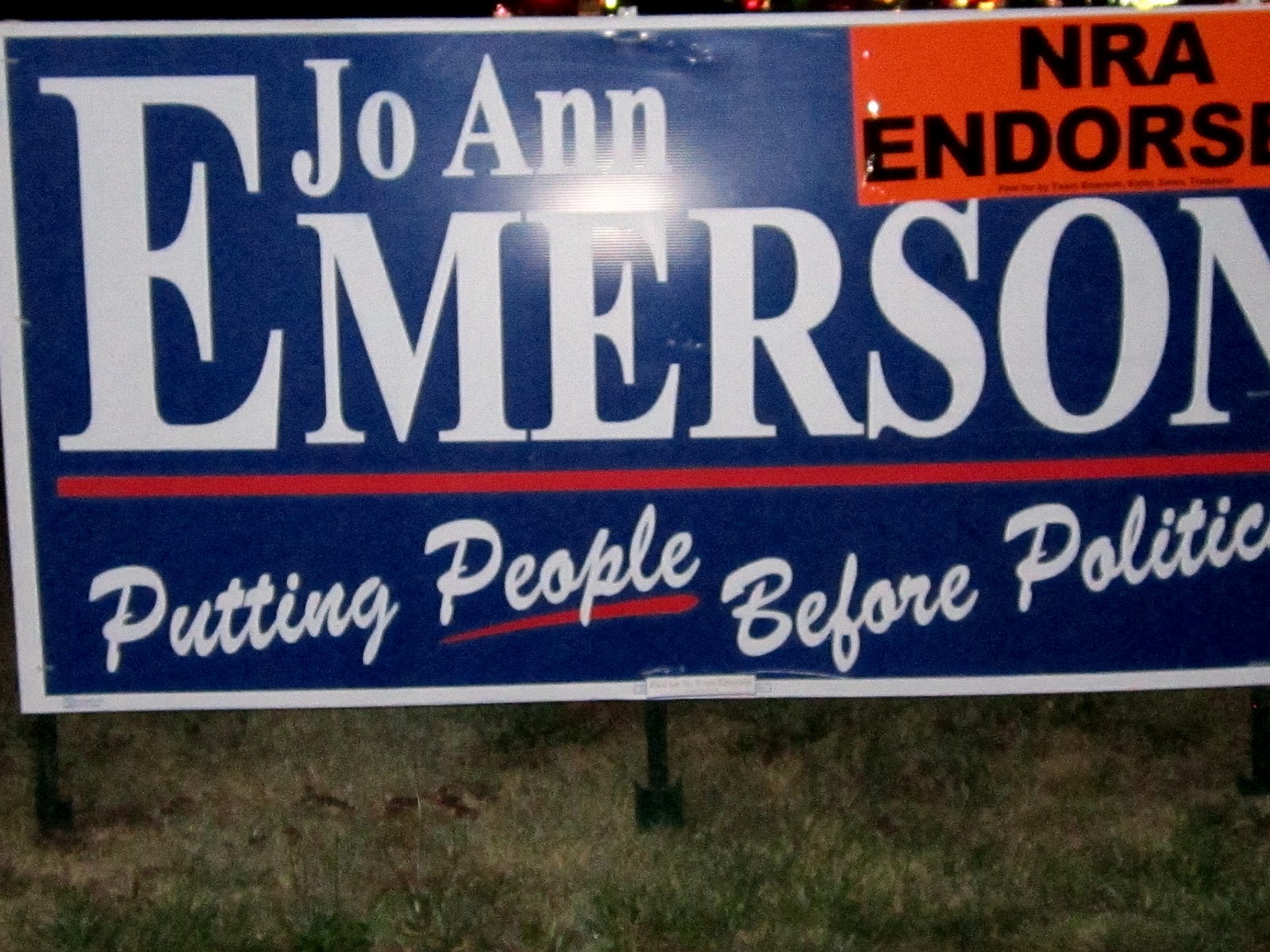
JoAnn Emerson's Modest Proposal


What's with the black stars on this American flag? Has the U.S. flag flying in Rep. JoAnn Emerson's Columbia Street office window been--egads!-- desecrated!? (Say it isn't so, Jo-Jo!)
Election season brings its litter of lawn signs enriching sign makers and impoverishing the rest of us. Tempting as it might be to suggest the enactment of legislation to abolish lawns themselves as a way of eliminating the eyesores, one has to assume the pols would find another way to do their electioneering; and since elected officials or their wannabes are not required to take a blanket oath (like doctors, for example) to do no harm, their tactics might include even greater destructive acts such as pounding nails into trees to hang their red, white and blue come-ons, or by further polluting the already imperiled night sky with LEDs.

So unless one has cultivated the kind of selective vision that elides the offending signs from the landscape, it's just another of the crass indignities to be borne in modern daily life. We're forced to look at their banal slogans while driving to the local food pantry to contribute canned goods to our jobless, hungry neighbors (last year in this rural hamlet alone our local food pantry distributed hundreds of thousands of pounds of food); or while heading over to yet another fund raising benefit for someone gravely ill fighting the good fight without adequate health “insurance;” or on the way to one of the frequent senseless and tragic funerals for a person in their prime slaughtered on the blood-and-guts-soaked killing fields that are our local highways by yet another drunk because let's face it, there's no public transportation and a very limited and expensive taxi service, and if a tipsy party-goer needs to get from point Alpha to point Omega it's likely going to be behind the wheel of an automobile. I do the best I can to block out the annoying placards from my view and resist allowing them to penetrate my consciousness.

 
But there is one on the horizon that has somehow darted in under the radar, and try as I might, I can't shake it off. Offered up by career U.S. Congresswoman and professional people person (and golfer?), JoAnn Emerson's campaign sign says: Putting People Before Politics. Now maybe this is where the rubber of my New York cynicism meets the road of my Missouri skepticism, but putting people...? What grip on which club would she even use for that? Is putting people even possible in any meaningful sense? Would they roll and fall into the hole, or just sort of pathetically flop over and convulsively twitch in place?

In theory I understand why she'd want to putt people before politics; and not only because “politics” is how she earns her daily bread ($165,200 per annum) and benefits you and I can only dream of, so the incentive to risk injuring “politics” with her putting iron really isn't there. But still, I'm not liking this idea of putting people., even small dimpled white roundish ones. Furthermore, I'm not quite buying that she does it successfully, as her message implicitly suggests.
I can hear the naysayers out there shouting me down, because, technically, she never claims that she sinks the putts in the hole, just that she makes the attempt. I concede the point, but I find it, if not exactly disingenuous, kind of weak on her part to announce all over her own district, to the very people who hold the power (or so we're told) to vote her back for more of the same ole, same ole that she's flailing around on the putting green; simply going through the motions. Has staff not informed her that even the perception that she may be engaged in false advertising could be extremely harmful to her re-election bid? Have they not advised her to add a clarifying modifier, perhaps something like: Putting (But Not in All Cases Sinking) People Before...etc.?

By now, some of you out there may be thinking that I'm pulling your leg, that I'm making some kind of “statement” about the false, one might say subpar, "choices" routinely presented by the electeds, or how they never really mean precisely what they say or say precisely what they mean, or both. To which I, doffing my plaid golf cap and bowing low from the waist of my pink and lime Lily Pulitzer golf togs, might retort: Play through!

When they go so far as to place the white elephant right there in the window for everyone to see, maybe we should take a freaking clue...? What good is transparency, if no one bothers to look? Or if when they do, they can't see what's staring them in the face?


Tuesday, June 5, 2012

Ian Bogost's Alien Phenomenology: The Baggage of Vivacity


“Christ almighty. Cancel the order.”
“What?”
“Cancel the cremation!”
“Stop yelling. Hope said it was okay, we have it in
writing!” And I ran to get the note from Mr. Plotsky, but
the visual of Mr. Plotsky’s helter-skelter craziness made
things worse.
“Frances, what have you involved us in?”
“She said we have a biological imperative! She said
we have to clear the decks!”
“What’s coming in for a landing? A UFO?”

--From Chap. 4 of Cooperative Village, “A Dunking A Day Keeps the Torturer Away”


In my novel Cooperative Village, I created a fictional character to represent the part of me who lags behind, who gleefully dances for perverts, who openly weeps at beauty and loss; the slowest bubble to the surface, I called her “the lovely retarded woman.” In one of my favorite scenes (one that anticipates the configuration aspect of Bogost's Tiny Ontology concept) the protagonist, Frances, rewards the lovely retarded woman for her help with a tedious project creating vocabulary flashcards for her husband's elementary school students. She presents her with an expansive gift removed from a curio cabinet of treasures—a kaleidoscope.

I showed her how to aim it a light source, look through the hole and manipulate the wheels, both in the same direction, in opposite directions, fast, slow, and spinning with abandon.

“Beautiful,” she said. “Beautiful. BEAUTIFUL. For me?”

“For you.”

She put her arms up in a “v” for victory.

The lovely retarded woman leaves her encounter with Frances refreshed, enriched, with victory in hand. (You'll have to read the book to see the curious effect their session together has on Frances.)

I don't have a kaleidoscope for philosopher, game designer, professor of Digital Media at the Georgia Institute of Technology, and author of Alien Phenomenology, Ian Bogost; anyway, it would be too rudimentary a tool for the operation at hand. There are certain things I sensed in reading and rereading this newest addition to OOO theory that his own book wishes to tell him, certain contradictions currently withdrawn from his perception that it wishes him to resolve in favor of freedom and greater ontological dignity. In the book's epigraph, Bogost posed a series of questions to his book.

Particle man, particle man
Doing the things a particle can
What's he like? It's not important
Particle man

Is he a dot, or is he a speck?
When he's underwater does he get wet?
Or does the water get him instead?
Nobody knows, Particle man

--They Might Be Giants, Particle Man

His book has answered him, but I don't think he's listening. The book didn't know he was being merely clever, and his book wants his attention. So as improbable as this all seems, it called out to me here in St. Francois County over Memorial Day weekend. For days now I've been worrying how to intervene, how to help? (Lives are at stake.) What medium would best deliver his book's message, most impress him with his book's urgent warnings? 

So even though it was painstaking and time consuming (and way more than he would ever do for me if the tables were turned) I made him an ontograph, or the beginnings of one (I ran out of Time and didn't get to finish in the “dense meanwhile,” so it's a WIP; besides it's better if he finishes it himself). I mean it to be an amalgam of a Latour litany and a Shore picture. As Bogost writes, “The Latour litany gathers disparate things together like a strong gravitational field. But the Shore ontograph takes things already gathered and explodes then into their tiny, separate, but contiguous universes.”

My ontograph is in the form of an index, a creative supplement (some new categories, some new entries to existing ones) to the one already created for Alien Phenomenology, offered with two hopes: 1) that it fulfills itself definitionally, index as that which “leads an observer to surmise a particular fact or draw a particular conclusion.” (From Webster's Third New International Dictionary); and 2) that as John Barth told us in Chimera: “The key to the treasure is the treasure.” Tittle and all!

Here are the index categories:

New Unit! addiction: alcohol-caused liver disease, 20; when I don't tweet, I might lose face, 76;

New Unit! Christianity: wounds of the mountain-Christ, 3; rapturous disappearance of humanity, 8; a great cathedral, 21; Carpentry, 85-111; Wonder, 113-134.

New Unit! Empire (hyperobject): U.S. Armed Forces, 1; Trinity Site, 1: 1862 Battle of Glorieta Pass, 1; Roswell Army Air Field, 1; Very Large Array antenna, 2; African elephant, 9; Harry Potter, keynote speeches, single malt-scotch, 12; volcano's network, 21; the palace of being, 21; Winnie the Pooh, 22; Slurpee, 23; who does the counting?, 27; pragmatic speculative realism, 29; the Voyager, 32; Offra of Mercia, 35; the Prussian empire, the Zionists, 39; the relationship of accumulation, 40; Coke Is It!, 44; Disney Concert Hall, 46; the latest gadgets, 48; subjects are subordinate, 48; Hostess Twinkie, 62; USSR, 66;

games: Being human the players can try to outwit one another in order to fool the interlocutor through deception, 14; the cancer that beats others at its own game, 39;

perception: of things, 27; ordering like an imperative, 27; bracketing our natural assumptions about, 32; arrested before, 50; as clear subject for phenomenological inquiry, 61; as ideative categorical intuition, 80; subjective universe of one object's, 83;

New Unit! prison: of your own devising, 3; dank halls of the mind's, 5; tragically blind to the distinction between doing and saying, 15; making things tidy, 15; of representation, 40; of human experience, 65; the pace of Twitter, 76;

I thought it might be further illuminating and fun to practice a little mereology. First, consider each these six categories individually, then as a whole, and then insert each entry into its proper place in the preexisting index and consider the larger whole. For instance, addiction would be inserted between Adams, Ansel and Adventure; Christianity between children: career goals for and Coke Is It (slogan); Empire (hyperobject) between Eames, Charles and Ray: Powers of Ten and entities, alliances among; and prison would nestle between preservation of units and process philosophy.

Then just sit back with a kick-ass cocktail and let the index perform the philosophical work. It's powerful! 

I think if Ian Bogost will do this and spend more time listening to his book (and maybe literally reading it aloud will help him), one of the things he will discern (and by no means is it the most important contradiction, but it's the one that jumped out at me, and showed itself as a symptom of a broader tendency) is a fundamental contradiction between calling literature out, as he does on page farty, for having "a preference for traditional narrative" [of precisely the sort insisted upon by James Wood] because it "acts as a correlationist amplifier,” and reifying Wood's self-serving status as arbiter of the "good" and "aesthetically successful." Even the lovely retarded woman wasn't that self-defeating.


Meanwhile, although we haven't used the term "correlationist amplifier," to describe James Wood, or Adam Kirsch, or Lev Grossman, or Laura Miller, or any of the other middlebrow gatekeepers, we in the litblogosphere, and most especially Edmond Caldwell at Contra James Wood and The Chagall Position and in his phenomenal new novel Human Wishes/Enemy Combatant, have been saying exactly that for years.


Tuesday, May 29, 2012

Rosie's Garden


I'd had the Yorkie a full week before a single “Puppy Lost” sign was posted on the community bulletin board at the Country Mart. I'd been checking daily because I really couldn't afford to care for a dog not yet housebroken—the tags, the shots, the chow, the gnawed slippers and ruined slobbered-upon sandals.

I pulled both staples out of the corkboard, accidentally removing a chunk of cork with my fingernails, and took the photocopied sign down to hold it under a brighter light; the better to scrutinize the color photograph above the description, telephone number with our 573 area code, and the caption: “Haf you scene my dog?” Not a day tripper from St. Louis touring the local wineries as I'd imagined in my primary scenario, too tanked up on slushy wine-a-ritas to realize her doggie hadn't hopped into the hatchback; I'd thought all sorts of things. Now I wondered—non-English speaker?

In the picture there were welts on Miranda's head between her ears, bright red ones that had healed under my care, squeezing the gel out of the aloe frond and applying it with a Q-tip, feeling her coat for ticks, chiggers, fleas (there were plenty of those), and I knew it was the very same dog. She was posed on a bale of hay, sleeping in the sun, a weathered red barn behind her. Could be anywhere: Highway D, Highway H, Highway Double O, or maybe out 32 a ways. Over yonder, as some of the locals might say.

I had named her Miranda from The Tempest because I'd found her cowering from a lightning storm in my garage; the dinged metal door's a hassle to raise and lower, so I leave it open unless we have a severe storm warning in the area; and there she was between the mulcher and my John Deere riding mower when I got home from work. At the first crash of thunder she had leapt into my arms and buried her little face in my neck, her wet nose poking under my collar, trying not to whimper. Innocence presuming protection. Lala it said her name was. Why not name her Missing A Good Long While or Gone A Whole Fucking Week, since that had been her destiny? I called the number, got a recording and left a message.

I had listened attentively to the outgoing message to discern what I could from the tone and timbre of the speaker's voice. Would I hear kindliness, a smiling voice, or a space cadet? (To lose a puppy! And one as loving, playful and sweet-tempered as Miranda.) But a penchant for passive neglect is undetectable to the ear, at least in such a perfunctory collection of words, at the tone, please leave a message. Maybe ever.

I tried as best I could to filter out the annoyance I was feeling toward this lackadaisical stranger, when I left my own number adding that I might have found her dog. My voice slanted italics on that might. Hours went by before she called back, evening into night; it was going on ten o'clock and, was I ever pissed off that she didn't have her phone on her hip, alert for a call on the first day the signs were posted, a full 1, 2, 3, 4, 5, 6, 7 days after her dog had gone missing? What is the matter with these people? What did I mean by that—these people—masters of dog? losers of dogs? narcissist lunatics?

I took down her address and directions, a few miles out of town, something about a creek and concrete culvert (my moat she had laughingly said) and told her she'd have her dog back in the morning; I could drop her off, unless she wanted to come get her now. No, the morning would be fine. Really? I would have exerted myself for you, I told this other woman's puppy; I would've hit the road in my pj's to get you back. Maybe she's crippled, suffers from night blindness; maybe there's a good reason, I softened, not wanting to perturb Miranda with my disgust.

We made the best of it, Miranda and I, our last night together. We tugged and tussled with a tassled throw pillow, I watched her ecstatically chew an old washcloth, we had extra treats; her, homemade dog biscuits I'd picked up at the Wednesday afternoon Farmer's Market at the VFW, and me a mookie bought there too. A mookie's basically an oversized oatmeal cookie, more scone than muffin, and once you have one, well...

I walked with her one last time down my gravel lane in the fizzling moonlight, both of us swiping at but not catching June bugs by the scores. Catch them for what? Though I'd been strict the whole week, this night I left my bedroom door ajar–private quarters, I had called out every time before she had yelped and scratched at the door, even in the middle of the night when she heard the toilet flush. But tonight we would snuggle, if you call her lying in the crook of my ankles, snuggling. Me, enjoying the scant weight of her, her warmth, breath, beating heart, giggling when she took to licking my toes while I wiggled and squirmed with abandon. It's not love yet, I thought (mistakenly), but another night of this toe-licking routine and it soon would be.

It was her first time in the car and I let her sit on my lap; it wouldn't be a long ride and the roads here are smooth, well-surfaced, straight, easy to travel. Not a crazy risk, to keep her so close. I saw the barn back from the road, the one in the picture, turned in the long driveway and thought, Miranda's home now, and I'm glad for her; but where am I? Where? Morning, the mistress of the house said as she approached the car, it was subtle but it sounded like mourning. Hi, I answered, wishing I were. This was going to be harder than I suspected.

Aiyee, LaLa, lalalalalalalala, puppy, baby, where did you go? To this nice lady's house for a visit? Now you come back to me; that's a good puppy dog. Come, do you have time for a Nescafé ? I'll show you my garden. You'll take whatever you want; I won't insult you with cash, unless you want cash. Do you? Rich bitch. No. Let's just get it over with. Miranda, poor thing, wasn't sure who to follow, whose feet to trod along under. Just go with her, I thought. Make the break. Go with the old lady, the craven one who cannot spell, the one who names you after a note, a syllable on the diatonic scale, third from last.

Flowers! I love flowers as you can see! We were in the midst of what they were calling on the news a Missouri flash drought, but soaker hoses were  irrigating her flower beds, row after row. Take what you want, my garden is your garden. It sounded like guard on in her pronunciation. En garde, I thought, my hand twitching, missing my rapier in its grip. 

The sprinkler was rotating, the cool droplets falling on the beds like a soft shower. These are my day lilies she said, improbably pointing to leafy red-stemmed vines. There are my nasturtium, another row exactly the same. I have tons of sunflowers, the birds eat the seeds—the chickadees, the whippoorwills. Is she blind, I wondered, putting on an act of sight? Unaware that all the beds contained but the same oily plant, more a weed to be precise, dangerous, unwanted?

If it's three, let it be, I called back to her, sprinting for my car, starting the engine and revving it for effect. Miranda, let's blow, I incanted under my breath because in America it would be wrong to say it out loud, the dog being her personal property. Let the puppy follow me home again anyway, I sang to the tune of a sea  shanty, haul away from the crazy lady who makes nosegays for her family, and tiaras for her pets, from her low bed of ivy, her very poison ivy. Mi-randa!


Tuesday, May 22, 2012

Body Blow


There's a rumor going around, and I hope with all my heart that it is just that—a rumor—that The Vault may be closing soon.

It's taking almost more discipline than I can muster, but I've assigned myself the unpleasant task of imagining my life this past year subtracted by The Vault. It's too big of a tally: the artistry, imagination, creativity and inspiration I would have missed out on, the friendships I might not have formed, the laughs, the dancing, delicious meals and local wine, and the enlivening sense that the world was coming to Farmington, the whole wide world, and that we were here to meet it and welcome it.

Would I have gone to the alternative secular nightlife options: bingo at the VFW, karaoke at Wild Buffalo Wings, bowling at the Family Fun Center, Trivia Night fundraisers for homeless vets (where the question of why we have such a category of human beings is never, ever addressed), or a half-dozen smoky bars where one gets to watch alleged grownups get wasted while listening to classic rock cover bands? Not on a dare.

I find myself thinking about that part in Collapse: How Societies Choose to Fail or Succeed when Jared Diamond is relating the aftermath of the deforestation on Easter Island, an act of communal ecocide, and the subsequent descent into starvation, population crash, and cannibalism. Letting The Vault go without a fight is the functional equivalent of handing an axe to the guy who was all set to chop down the very last tree, after sharpening the blade.

Our motto here is Tradition and Progress: in which of these categories would The Vault failing be placed? Farmington, are you sure you want to intentionally chop down our tree? After all, it is the only one as far as the eye can see. As a matter of survival, wouldn't it be nice to continue to have the oxygen it gives off, the shade and fruit it provides, how it serves as a marker on the horizon distinguishing this place from all the area surrounding it?

What would a fight for the flourishing of The Vault look like, anyway? It would look like a party. We wouldn't even know we were fighting we'd be having such a good time. In the short-term it would mean prioritizing attendance at upcoming shows, having dinner there, bringing some friends you've been wanting to do something fun with for a while, packing the 87-seat house, and then doing it again, and again, until it's just what we do. 

It would mean a recognition that we are fighting so that the I's—Inertia, Ignorance and Indifference—don't triumph yet again over something that's sweet and real and wonderful. That these two native Southeast Missouri owners—Tim and Kerry Smith from Fredericktown—dreamt a beautiful dream and made it manifest. FOR US! They’ve given their all to keep the embers sparking, hoping the torch lights and stays lit. And why shouldn't it? It's a beautiful, blazing torch throwing fiery beams into the darkness, connecting our community with other heat-seekers all over the country in a constellation of alive, attentive, get-up-and-boogie listeners who rejoice, not regret, their lives.

It might mean a couple of generous souls in a position to help financially coming forth with a few no-strings checks to the owners. Such miraculous things do happen on occasion. A few years ago my friend Herb Leibowitz planned to cease publishing Parnassus, A Poetry Review, when it had become financially untenable. But after reading an article in the Wall Street Journal an “angel” came up with an anonymous gift of $50,000 to keep it going. I'm guessing that for The Vault the angel wings wouldn't have to be a third as costly as that.

And what would be gained exactly by keeping The Vault as a venue for live, original music viable? A place for a young musician like Gracie Minnis or stand-up comic Steve Hull, for example, to have the chance to see outside talent, as they develop their own performance skills. A place for local bands like Brokeneck or solo acts like Casey Reeves and Mike McClanahan to perform and build their fan bases. A vibrant social space where outsiders and newcomers, like me, can seek out the other creative people around town, the folks with enough on the ball to give the television a rest when some fantastic bands like The Blackberry Bushes, Rum Drum Ramblers, or Izzy and the Catastrophics are blowing through town on their way to New Orleans, Chicago or Portland.

If The Vault doesn't succeed it will likely be used as a warning with which to bludgeon other beautiful dreamers not even to try, not to risk. Oh yeah, well, they attempted that at The Vault and it didn't go over, so don't bother. And that would be a setback for all the enterprises that haven't yet come into being, a preemptive abortion of imaginative possibilities, idiosyncratic visions, individual (non-corporate) entrepreneurial expressions. It sends exactly the wrong message to young people who envision a modest livelihood in arts and culture here—nope, you have to leave the area if you wish to be successful. We'll just continue being known for our meth labs and prison industry, thank you very much; escapism and punishment, punishment, punishment is what we prefer to choose!

So here we are on Easter Island, the axe poised to fell the last tree. But instead of chopping, maybe we use the sharp edge of the blade to aerate the dirt around the roots so it can thrive? And then maybe we dig a new hole, making a space not far from this one for another sapling, and then another, until we have a scene going: a jazz club, a comedy club, a cinémathèque, a playhouse, a chamber orchestra, a string quartet, a community chorus, a bookstore, a bistro, a...___________, fill in the blank with your own beautiful dream.